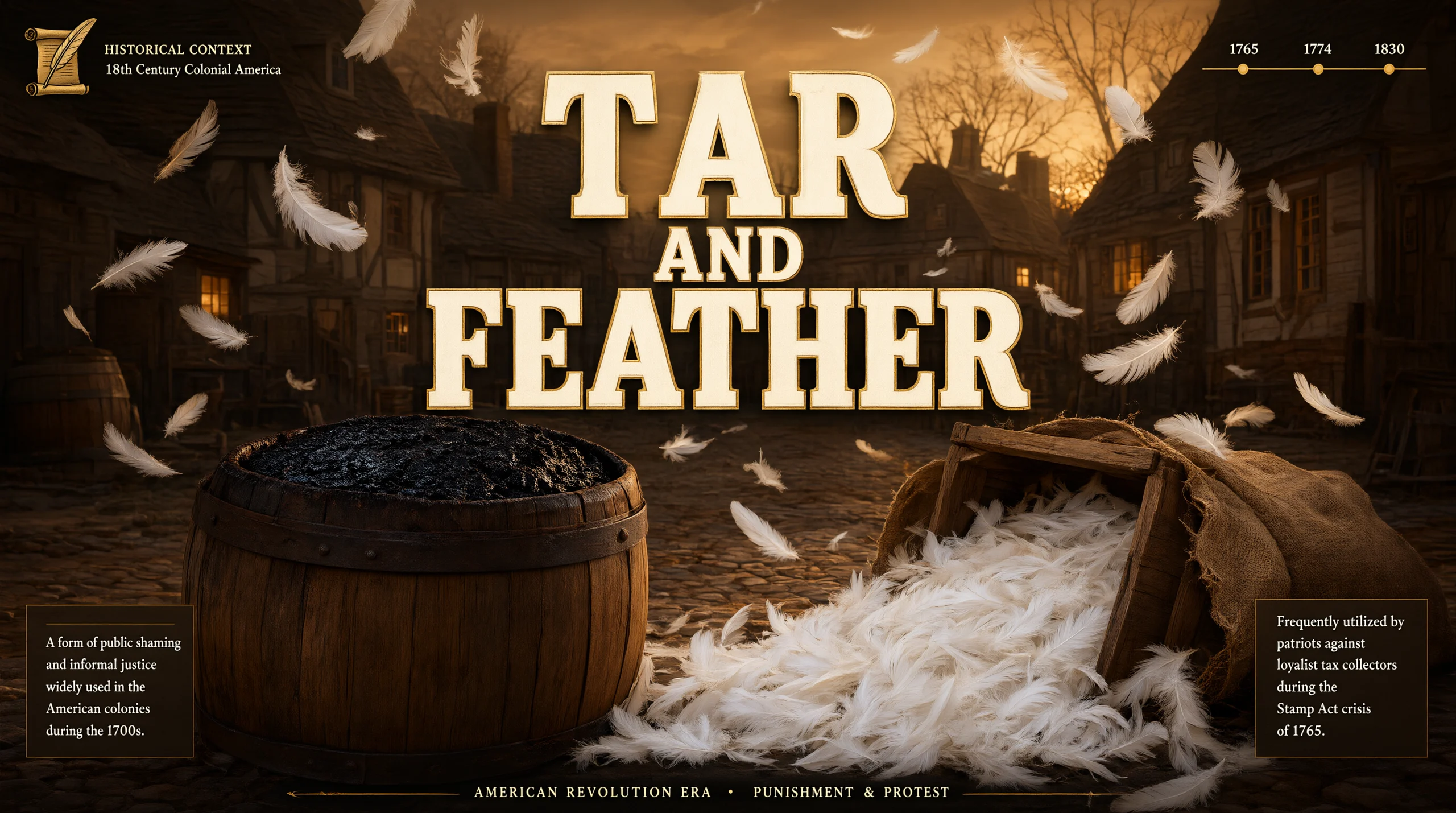
The phrase “tar and feather” refers to an old form of public punishment in which a person was covered with hot tar or another sticky substance and then covered with feathers. Historically, this practice was used to shame, intimidate, and publicly humiliate someone accused of wrongdoing. Today, the expression is mainly used figuratively to describe severe public criticism, humiliation, or punishment.
You may encounter this phrase in history books, novels, political discussions, movies, and everyday conversations. Although it sounds unusual, it carries a strong negative meaning because it is connected to public humiliation and mob punishment. Understanding the phrase helps you recognize its historical background, emotional tone, and modern usage. It is also important to distinguish between the literal historical practice and the figurative expression used in modern English.
Quick Answer
Tar and feather means to cover someone with a sticky substance, traditionally tar, and then cover them with feathers as a form of public humiliation and punishment. Today, the phrase often describes publicly shaming, criticizing, or treating someone harshly for their actions or opinions.
Why Do People Confuse Tar and Feather?
People sometimes misunderstand “tar and feather” because it combines two ordinary words that have separate meanings.
- Tar is a dark, thick, sticky substance traditionally used in construction and other industrial applications.
- Feather is the soft covering found on birds.
When these words appear together, however, they describe a historical punishment rather than two unrelated objects.
Another reason for confusion is that the phrase has both literal and figurative meanings. In historical writing, it can describe an actual punishment. In modern conversations, it usually expresses anger, public criticism, or humiliation without referring to the physical act.
First Word: Tar
Tar is a thick, dark, sticky substance produced from materials such as coal or wood, or found naturally in certain forms.
It has traditionally been used for waterproofing, road construction, roofing, and other industrial purposes.
Meaning of Tar
As a noun, tar refers to the sticky material itself.
As a verb, to tar means to cover something with tar or a similar substance.
Examples:
- Workers used tar to protect the wooden roof.
- The old road was covered with a dark layer of tar.
- Historically, tar was associated with certain forms of public punishment.
In the expression “tar and feather,” tar represents the sticky substance used to make feathers adhere to a person’s body or clothing.
Second Word: Feather
A feather is one of the lightweight structures that cover a bird’s body. Feathers help birds fly, stay warm, and protect their skin.
Meaning of Feather
The word feather is commonly used as a noun, but it can also appear as a verb in certain contexts.
Examples:
- A colorful feather fell from the bird.
- The child found a white feather in the garden.
- The costume was decorated with soft feathers.
In the historical expression “tar and feather,” feathers were placed over the sticky substance, making the person look unusual and attracting public attention.
Tar and Feather: Comparison Table
| Feature | Tar | Feather |
| Basic meaning | Thick, sticky substance | Bird’s body covering |
| Word type | Noun and verb | Noun and verb |
| Main association | Waterproofing and construction | Birds and flight |
| Historical role | Sticky coating | Material attached to the coating |
| Symbolic association | Humiliation and punishment | Public spectacle |
Together, the words describe a historical method of public humiliation.
When to Use Tar and Feather
Use “tar and feather” when discussing historical punishment, public humiliation, or figurative expressions of severe criticism.
1. Historical Discussions
Use the phrase when explaining historical events involving public punishment.
Example: Some protesters in colonial America used tar and feathering to intimidate people they considered political enemies.
2. Figurative Conversations
Use it when describing a situation in which someone faces strong public criticism.
Example: The manager joked that the employees would tar and feather him if he canceled their holiday.
3. Political Discussions
The expression can describe public anger toward politicians or government officials.
Example: The politician feared that voters would figuratively tar and feather him after the controversial decision.
4. Literature and Storytelling
Writers use the phrase to create historical settings or communicate public anger.
Example: The novel described a town where angry residents threatened to tar and feather the dishonest merchant.
12 Examples of Tar and Feather in Sentences
Here are practical examples showing how the expression works in different situations.
- The angry crowd threatened to tar and feather the tax collector.
- Tar and feathering was a form of public humiliation in earlier centuries.
- The history teacher explained why protesters used tar and feathering.
- The politician joked that the public would tar and feather him after his announcement.
- The villagers wanted to punish the dishonest businessman.
- The expression tar and feather appears in several historical accounts.
- The angry residents threatened to tar and feather the corrupt official.
- The movie showed a historical scene involving tar and feathering.
- The newspaper described the public’s reaction as an attempt to figuratively tar and feather the mayor.
- The author used the phrase to represent public anger and humiliation.
- Nobody wanted to become the target of the angry crowd’s criticism.
- The expression reminds readers of the harsh punishments used in the past.
Common Mistakes When Using Tar and Feather
Even fluent English speakers can misunderstand this expression. Here are some common mistakes to avoid.
1. Treating it as an ordinary combination of two objects
Incorrect understanding: Tar and feather simply means tar and a bird’s feather.
Correct understanding: Together, the words describe a historical punishment.
2. Assuming it always describes a physical punishment
The phrase is frequently used figuratively in modern English. It can describe public criticism or humiliation without anyone being physically harmed.
3. Confusing tar and feather with tar and feathers
Both forms can appear in English, depending on the sentence.
- Tar and feather: Commonly used as a verb phrase.
- Tar and feathers: Commonly used as a noun phrase describing the punishment or its materials.
4. Using it in positive situations
The expression has a strongly negative meaning. It is not suitable for describing praise, appreciation, or friendly celebration.
5. Ignoring its historical background
Understanding its connection to mob punishment helps explain why the phrase sounds threatening or dramatic.
Memory Trick: How to Remember Tar and Feather
A simple way to remember the expression is to connect each word with its role:
- Tar = Sticky substance
- Feather = Bird covering
- Tar and feather = Historical public humiliation
Think of a sticky substance holding feathers against a person’s clothing or body. This mental picture makes the expression easier to understand and remember.
American vs British English
“Tar and feather” is understood in both American and British English. Its basic meaning does not change between the two varieties.
However, the expression has a particularly strong connection with American history, especially colonial-era protests and political resistance.
| Feature | American English | British English |
| Meaning | Public humiliation through tar and feathering | Same meaning |
| Historical association | Colonial protests and political disputes | Historical punishment and public disorder |
| Figurative usage | Public criticism or humiliation | Public criticism or humiliation |
| Spelling | Tar and feather | Tar and feather |
Example in American English: The protesters threatened to tar and feather the official.
Example in British English: The historian discussed the practice of tarring and feathering as a form of public humiliation.
Both sentences are grammatically correct.
Similar Words and Related Expressions
Several English words and expressions are related to the meaning of tar and feather. However, they do not all have exactly the same meaning.
| Word or Expression | Simple Meaning |
| Humiliate | Make someone feel ashamed |
| Shame | Cause embarrassment or disgrace |
| Embarrass | Make someone feel uncomfortable |
| Ridicule | Make fun of someone |
| Mock | Laugh at someone in an insulting way |
| Condemn | Express strong disapproval |
| Punish | Make someone suffer a consequence for wrongdoing |
| Ostracize | Exclude someone from a group |
| Publicly disgrace | Damage someone’s reputation in public |
| Shame publicly | Make someone feel ashamed in front of others |
| Persecute | Treat someone cruelly or unfairly |
| Denounce | Publicly criticize someone or something |
These expressions can help you understand the broader meaning of tar and feather, especially when it is used figuratively.
Final Verdict: What Does Tar and Feather Really Mean?
Tar and feather describes a historical punishment in which a person was coated with a sticky substance and covered with feathers to create public humiliation.
In modern English, the expression is often figurative. It can describe severe public criticism, embarrassment, or social humiliation. Its meaning depends on the context, but it almost always carries a negative tone.
FAQs:
1. What does tar and feather mean in simple English?
Tar and feather means covering someone with a sticky substance and feathers as a form of public punishment and humiliation. Today, it can also mean publicly criticizing or shaming someone.
2. Is tar and feather an idiom?
Yes. It can function as an idiomatic expression when used figuratively to describe public humiliation, harsh criticism, or disgrace.
3. Where did tar and feather originate?
The practice has historical roots dating back before colonial America. It became particularly associated with political protests and public intimidation in colonial America during the 18th century.
4. Why did people tar and feather others?
People used this punishment to shame, intimidate, and publicly disgrace individuals. It was sometimes directed at people accused of political misconduct, unpopular actions, or violating community expectations.
5. Is tar and feather still used today?
The expression is still used in modern English, especially in historical discussions, literature, and figurative conversations. It is not a normal or accepted form of punishment today.
6. What is another word for tar and feather?
Depending on the context, similar expressions include humiliate, publicly shame, disgrace, ridicule, and condemn. However, none of these completely captures the historical meaning.
7. Is tar and feather American or British English?
It is understood in both American and British English. However, the practice is especially associated with colonial American history and political protests.
Remember This
- Tar: A thick, sticky substance.
- Feather: A covering found on birds.
- Tar and feather: A historical form of public humiliation and punishment.
- Modern meaning: To publicly shame, criticize, or humiliate someone.
- Tone: Negative, dramatic, and sometimes threatening.
Conclusion
The expression “tar and feather” has a powerful historical meaning connected to public punishment, intimidation, and humiliation. By understanding the meanings of its individual words and their historical connection, you can recognize the expression more easily in books, conversations, and historical discussions.
Today, it is commonly used figuratively to describe strong public criticism or embarrassment. If you encounter it in American history, literature, or everyday English, remember that it carries a negative meaning associated with disgrace and public shame.

I’m Amelia Rose, an enthusiastic writer who enjoys exploring better, clearer, and more natural ways to express ideas. I create helpful content that makes finding alternative phrases simple, useful, and enjoyable for everyone.