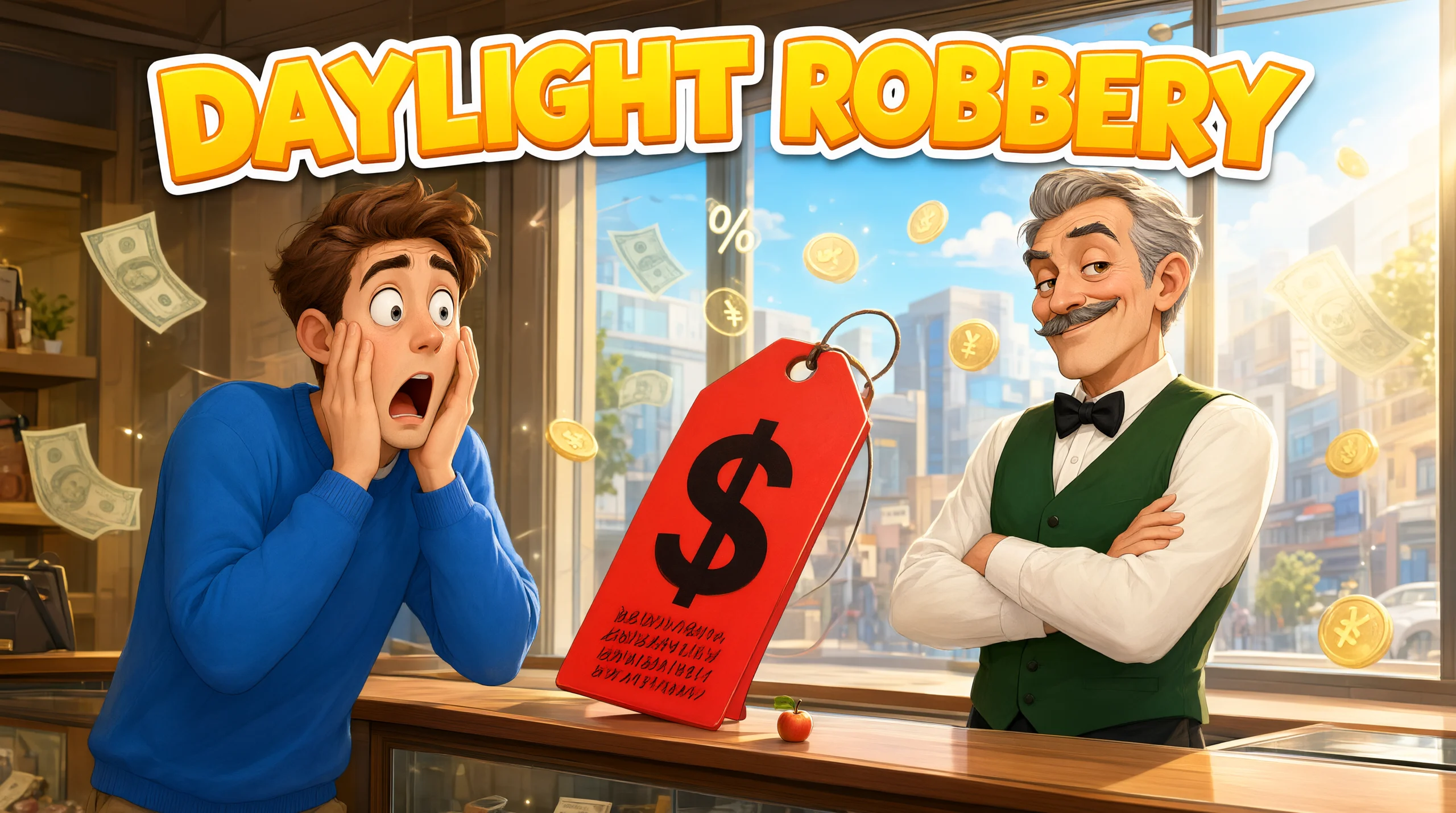
The phrase “daylight robbery” is a common English idiom used when something costs far more than it is worth or when someone is charged an unfairly high price. It expresses surprise, frustration, or anger about an unreasonable cost. For example, if a shop charges $50 for a simple notebook that normally costs $5, you might say, “That price is daylight robbery!”
Although the phrase contains the words daylight and robbery, it does not usually describe an actual crime. Instead, it is a figurative expression that compares an unfair price to an obvious act of stealing. English speakers commonly use it in everyday conversations, informal discussions, and situations involving overpriced products or services. Understanding this idiom will help you recognize its meaning, use it naturally, and distinguish it from similar expressions such as overpriced, rip-off, and highway robbery.
Quick Answer
Daylight robbery is an informal English idiom meaning an extremely unfair or unreasonable price charged for something. It describes a situation where people feel they are paying much more than something is worth. For example, paying $20 for a small cup of ordinary coffee might feel like daylight robbery.
Why Do People Confuse Daylight Robbery?
People sometimes misunderstand daylight robbery because its literal meaning seems connected to stealing something during the daytime.
However, the expression has a figurative meaning. It describes unfair pricing rather than necessarily referring to a criminal act.
There are three main reasons people confuse this phrase:
- Literal meaning: The words suggest an actual robbery happening in daylight.
- Figurative meaning: The expression refers to excessive or unreasonable prices.
- Similar expressions: People sometimes confuse it with highway robbery, rip-off, and overcharging.
The important point is that daylight robbery usually expresses an opinion about how unfairly expensive something is.
First Word: Daylight
Daylight is a noun that means natural light from the sun during the daytime.
It refers to the period when the sun is visible and the surroundings are naturally illuminated.
Examples:
- We arrived before daylight.
- The room looks brighter in daylight.
- They finished their journey in daylight.
- Daylight makes it easier to see outside.
In the idiom daylight robbery, the word daylight helps create the image of something so outrageous that it happens openly and without shame.
Second Word: Robbery
Robbery is a noun that refers to the crime of taking someone’s property by using force, threats, or intimidation.
In everyday English, however, people also use the word figuratively to describe something extremely unfair or unreasonable.
Examples:
- The police investigated the bank robbery.
- The robbery happened late at night.
- Charging that much for a basic service is robbery!
- That ticket price feels like daylight robbery.
In the expression daylight robbery, robbery is not normally used in its strict legal sense. It emphasizes how unfair or excessive a price seems.
Daylight Robbery vs Similar Expressions
| Expression | Meaning | Example |
| Daylight robbery | An extremely unfair or excessive price | $100 for a basic haircut is daylight robbery. |
| Highway robbery | An outrageously unfair price or deal | That hotel charge is highway robbery. |
| Rip-off | Something sold at an unfairly high price | This phone case is a rip-off. |
| Overpriced | More expensive than something is worth | The restaurant is overpriced. |
| Overcharging | Asking someone to pay more than the correct amount | The mechanic is overcharging us. |
| Expensive | Costing a lot of money | This jacket is expensive. |
These expressions are related, but they are not always interchangeable. For example, expensive is neutral, while daylight robbery strongly communicates dissatisfaction with a price.
When Should You Use Daylight Robbery?
Use daylight robbery when you believe someone is charging an unreasonable amount for a product, service, ticket, meal, or other purchase.
It is especially useful in informal conversations when you want to express frustration or disbelief about a price.
Use it in these situations:
- Shopping: When a product costs much more than expected.
- Restaurants: When food or drinks seem unreasonably expensive.
- Travel: When hotels, transport, or tickets have excessive prices.
- Services: When repair work or other services seem overpriced.
- Entertainment: When admission fees are surprisingly high.
Example:
“Ten dollars for a bottle of water? That’s daylight robbery!”
This sentence shows that the speaker considers the price completely unreasonable.
12 Examples of Daylight Robbery in Everyday English
Here are practical examples that show how to use this idiom naturally in different situations.
1. Shopping: Charging $200 for those ordinary shoes is daylight robbery.
2. Restaurants: The restaurant charged us $15 for a small sandwich. What daylight robbery!
3. Travel: The hotel wanted $500 for one night. That’s daylight robbery.
4. Transportation: Paying so much for a short taxi ride feels like daylight robbery.
5. Education: The school charges an unreasonable amount for basic supplies. It’s daylight robbery.
6. Technology: $100 for a simple phone charger is daylight robbery.
7. Entertainment: Those concert ticket prices are daylight robbery.
8. Repairs: The mechanic charged me $300 for a minor repair. That’s daylight robbery!
9. Clothing: This store wants $80 for a basic T-shirt. What a daylight robbery!
10. Groceries: The price of these vegetables is daylight robbery.
11. Accommodation: Charging extra fees for every small hotel service is daylight robbery.
12. Everyday conversation: “I paid $25 for two cups of coffee.” “Seriously? That’s daylight robbery!”
These examples demonstrate that the phrase works in many everyday situations involving unreasonable prices.
Common Mistakes When Using Daylight Robbery
Although this idiom is easy to understand, English learners sometimes make mistakes when using it.
1. Taking It Literally
Incorrect understanding: Thinking that daylight robbery only describes stealing something during the day.
Correct understanding: It usually describes an extremely unfair price.
2. Using It for Every Expensive Product
Not everything expensive is daylight robbery.
For example:
- “This luxury watch costs $5,000.” This simply describes an expensive product.
- “This ordinary watch costs $5,000.” This might be daylight robbery if the price is considered unreasonable.
3. Confusing It with Actual Theft
Daylight robbery is generally figurative, while actual robbery refers to a criminal act.
4. Using It in Highly Formal Writing
The expression is informal. In academic or professional writing, alternatives such as unreasonably expensive, excessively priced, or unfairly charged may be more appropriate.
5. Forgetting the Article in Some Sentences
When using the expression as a noun phrase, remember that it commonly appears with an article.
- Correct: That’s daylight robbery.
- Correct: What a daylight robbery!
- Incorrect: That’s a daylight robberies.
Memory Trick: How to Remember Daylight Robbery
A simple way to remember this idiom is to imagine someone openly charging an outrageous price in broad daylight.
Think about these two words:
- Daylight: Something happening openly, where everyone can see it.
- Robbery: Taking something that belongs to another person.
Together, they create the image of someone taking too much money through an unfair price.
Easy memory sentence:
“Paying $50 for something worth $5 is daylight robbery!”
Remember: It is about unfair prices, not necessarily real stealing.
Daylight Robbery in American vs British English
Daylight robbery is especially familiar in British English and is also understood in other varieties of English, including American English.
However, speakers may prefer different expressions depending on the region.
| British English | American English | Meaning |
| Daylight robbery | Rip-off | An unfair price |
| That’s daylight robbery! | That’s a rip-off! | Something is unreasonably expensive |
| What a rip-off! | What a rip-off! | An unfair deal |
| Overpriced | Overpriced | More expensive than expected or justified |
| Highway robbery | Highway robbery | An outrageously unfair price |
British English example:
“£30 for a basic meal? That’s daylight robbery!”
American English example:
“$30 for a basic meal? That’s a total rip-off!”
Both expressions communicate dissatisfaction with an unreasonable price.
Similar Words and Expressions
If you want to expand your English vocabulary, these expressions can help you describe unfair prices and expensive purchases.
1. Rip-off
Something that costs much more than it is worth or involves an unfair deal.
Example: That online course was a complete rip-off.
2. Highway Robbery
An informal expression describing an extremely unreasonable price.
Example: Charging $100 for a basic service is highway robbery.
3. Overpriced
Something that costs more than its reasonable value.
Example: The restaurant serves overpriced food.
4. Overcharging
Charging someone more money than they should reasonably or correctly pay.
Example: The company is overcharging its customers.
5. Extortionate
An adjective describing an unreasonably high price or demand.
Example: The hotel charges extortionate prices during holidays.
6. Excessive
More than what is reasonable, necessary, or acceptable.
Example: The delivery fee is excessive.
7. Exorbitant
An adjective describing an extremely high price.
Example: The shop sells furniture at exorbitant prices.
8. Unreasonable
Something that is not fair, sensible, or justified.
Example: The customer complained about the unreasonable charges.
Final Verdict: What Does Daylight Robbery Really Mean?
Daylight robbery is an informal English idiom that describes an extremely unfair, excessive, or unreasonable price. People use it when they feel that a product or service costs far more than it should.
It is not generally about actual theft. Instead, it expresses frustration, surprise, or criticism about unfair pricing. It is closely related to expressions such as rip-off, highway robbery, and overpriced.
FAQs:
1. What does daylight robbery mean in simple words?
Daylight robbery means charging someone an extremely high or unfair price for something. It is an informal expression used to show frustration about excessive costs.
Example: Paying $50 for a basic meal is daylight robbery.
2. Is daylight robbery a slang or an idiom?
Daylight robbery is an idiom. It has a figurative meaning that cannot be understood simply by looking at the individual words. It is also informal and commonly used in everyday conversations.
3. Is daylight robbery a British expression?
Yes, daylight robbery is particularly familiar in British English. However, people in other English-speaking countries can understand and use it too.
4. What is another word for daylight robbery?
Common alternatives include rip-off, highway robbery, overcharging, and exorbitant pricing. The best alternative depends on the situation and the meaning you want to communicate.
5. Can daylight robbery describe something other than money?
Yes, it can sometimes describe an unfair deal or unreasonable demand involving more than just a direct purchase. However, its most common use relates to excessive prices and charges.
6. What is the difference between daylight robbery and highway robbery?
Both expressions describe extremely unfair or excessive prices. Daylight robbery is particularly common in British English, while highway robbery is also widely recognized as an informal expression for an outrageous charge.
7. Is daylight robbery formal or informal?
Daylight robbery is informal. It is suitable for everyday conversations, casual writing, and discussions about prices. In formal writing, use expressions such as excessive pricing or unreasonable charges.
Remember This
- Daylight robbery means an extremely unfair or unreasonable price.
- It is an informal English idiom.
- It is particularly familiar in British English.
- It is similar to rip-off and highway robbery.
- It usually describes excessive prices rather than actual theft.
Conclusion
Understanding the phrase daylight robbery makes everyday English conversations easier and helps you express your feelings about unfair prices. If someone charges too much for food, clothing, transportation, or services, this idiom communicates surprise and dissatisfaction in a natural way.
Remember that daylight robbery is not usually about someone committing an actual crime during the daytime. It is a figurative expression for an outrageous price. Use it when something seems far more expensive than it should be, and you will sound more natural and confident in everyday English.

I am Camden Thomas, an Administrator at SaysReply. I help maintain our platform and ensure readers find clear, natural, and useful alternative ways to express their thoughts every day.