Have you ever wondered if to use blatant or flagrant when describing something obvious, offensive, or unacceptable? These two English words are closely related, but they are not interchangeable in every situation. Both describe behavior or actions that are impossible to ignore, yet they emphasize different qualities. Understanding the difference can help you choose the right word in everyday conversations, academic writing, professional communication, and formal discussions.
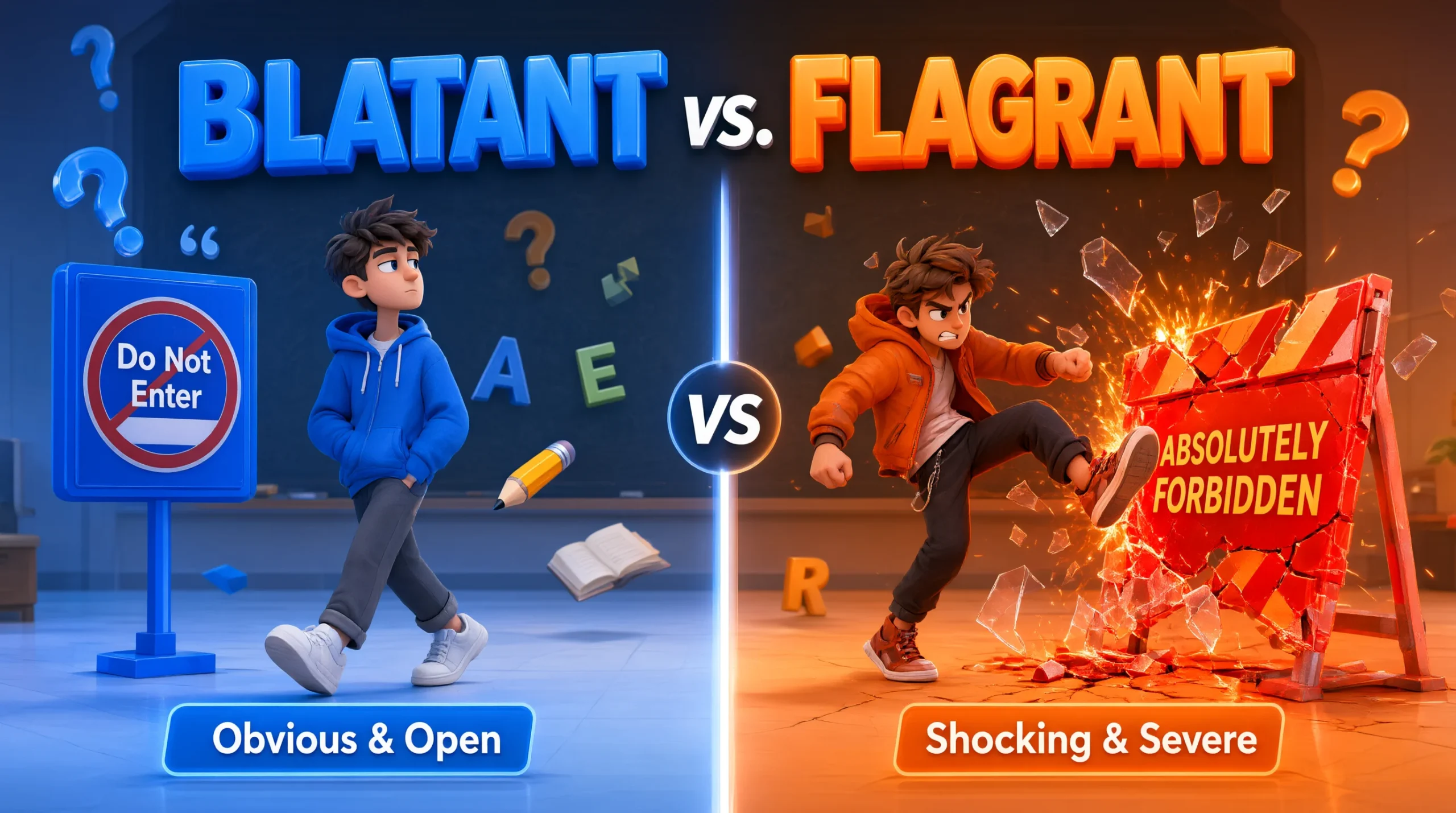
The main difference between blatant and flagrant is that blatant describes something that is very obvious, noticeable, or done without trying to hide it, while flagrant describes something shockingly wrong, offensive, or unacceptable. For example, a blatant lie is an obvious lie, whereas a flagrant violation is a serious and openly unacceptable breach of a rule. Learning their meanings, tones, and common usage patterns will help you use both words naturally and confidently.
Quick Answer: Blatant vs Flagrant
Blatant means obvious, noticeable, or done openly without shame. Flagrant means extremely wrong, offensive, or unacceptable, especially when someone openly breaks a rule or standard. Use blatant to emphasize visibility and flagrant to emphasize the seriousness of wrongdoing. For example, a blatant lie and a flagrant violation.
Why Do People Confuse Blatant and Flagrant?
People often confuse these words because both can describe actions that are openly displayed and difficult to ignore. They also frequently appear in negative situations involving dishonesty, disrespect, rule-breaking, and misconduct.
However, their main emphasis is different:
- Blatant focuses on how obvious or noticeable something is.
- Flagrant focuses on how shockingly wrong or unacceptable something is.
For example:
- The student made a blatant attempt to cheat. This emphasizes how obvious the attempt was.
- The student committed a flagrant violation of school rules. This emphasizes the seriousness of the misconduct.
The words sometimes overlap, but choosing the correct one makes your meaning more precise.
First Word: What Does Blatant Mean?
Blatant is an adjective that describes something extremely obvious, noticeable, or openly done without embarrassment or an attempt to hide it.
It is commonly used when someone does something so openly that other people can easily recognize it.
The word often carries a negative meaning, particularly when describing dishonesty, disrespect, unfairness, or inappropriate behavior.
Simple Definition of Blatant
Blatant means:
- Extremely obvious or noticeable.
- Done openly without trying to hide it.
- Clearly inappropriate or dishonest.
- So evident that it is difficult to ignore.
Examples of Blatant in Sentences
- The politician told a blatant lie during the interview.
- The referee ignored a blatant foul.
- Her blatant disrespect upset the entire team.
- The company showed blatant disregard for customer complaints.
- Everyone noticed his blatant attempt to avoid responsibility.
Common Expressions With Blatant
- Blatant lie
- Blatant mistake
- Blatant disregard
- Blatant disrespect
- Blatant cheating
- Blatant violation
- Blatant discrimination
- Blatant attempt
Remember: Blatant is particularly useful when you want to emphasize that something is obvious, open, or impossible to overlook.
Second Word: What Does Flagrant Mean?
Flagrant is an adjective that describes something shockingly bad, offensive, or unacceptable. It is especially common when discussing serious violations of rules, laws, standards, or moral principles.
Unlike blatant, which emphasizes visibility, flagrant emphasizes the seriousness and unacceptable nature of an action.
Simple Definition of Flagrant
Flagrant means:
- Shockingly wrong or offensive.
- Clearly violating a rule or standard.
- Extremely unacceptable behavior.
- An obvious and serious act of misconduct.
Examples of Flagrant in Sentences
- The player received a penalty for a flagrant foul.
- The company committed a flagrant violation of safety regulations.
- His actions showed a flagrant disregard for the law.
- The judge criticized the flagrant abuse of authority.
- The employee was dismissed for flagrant misconduct.
Common Expressions With Flagrant
- Flagrant violation
- Flagrant foul
- Flagrant disregard
- Flagrant abuse
- Flagrant misconduct
- Flagrant breach
- Flagrant injustice
- Flagrant offense
Remember: Flagrant is the stronger choice when you want to emphasize that an action is seriously wrong, offensive, or unacceptable.
Blatant vs Flagrant: Comparison Table
The following table explains the important differences between these two words.
| Feature | Blatant | Flagrant |
| Part of speech | Adjective | Adjective |
| Main meaning | Extremely obvious | Shockingly wrong |
| Main emphasis | Visibility | Serious wrongdoing |
| Tone | Usually negative | Strongly negative |
| Common usage | Lies, mistakes, disrespect | Violations, misconduct, fouls |
| Behavior | Open and noticeable | Seriously unacceptable |
| Example | Blatant lie | Flagrant violation |
| Everyday use | Very common | More formal |
| Main question | How obvious is it? | How seriously wrong is it? |
Key difference: Blatant describes how clearly something can be seen or recognized, while flagrant describes how seriously unacceptable something is.
When Should You Use Blatant or Flagrant?
Choosing between these words becomes easier when you consider what you want to communicate.
When to Use Blatant
Use blatant when something is extremely obvious, openly displayed, or impossible to overlook.
It is especially suitable for:
- Obvious dishonesty.
- Open disrespect.
- Clearly visible mistakes.
- Unfair treatment.
- Actions performed without shame.
Examples:
- The manager made a blatant error in the report.
- His blatant dishonesty damaged his reputation.
- The company demonstrated blatant disregard for employee concerns.
When to Use Flagrant
Use flagrant when describing serious wrongdoing, unacceptable behavior, or a major violation of established rules.
It is especially suitable for:
- Serious legal violations.
- Major rule-breaking.
- Sports misconduct.
- Abuse of authority.
- Serious ethical violations.
Examples:
- The organization committed a flagrant breach of regulations.
- The player was punished for a flagrant foul.
- The official was accused of flagrant abuse of power.
Can You Use Both Words in the Same Situation?
Yes. Sometimes both words can describe the same action, but they communicate slightly different ideas.
For example:
- The company committed a blatant violation of safety rules.
- The company committed a flagrant violation of safety rules.
The first sentence emphasizes that the violation was obvious. The second emphasizes that the violation was seriously unacceptable.
12 Examples of Blatant vs Flagrant in Sentences
Understanding both words through practical examples makes their differences easier to remember.
| Blatant Example | Flagrant Example |
| He told a blatant lie. | He committed a flagrant violation of the law. |
| The referee missed a blatant foul. | The referee punished the player for a flagrant foul. |
| Her blatant disrespect shocked everyone. | His flagrant misconduct resulted in dismissal. |
| It was a blatant attempt to deceive customers. | It was a flagrant abuse of authority. |
| The report contained a blatant error. | The company committed a flagrant breach of regulations. |
| His blatant cheating was easy to notice. | The athlete received a penalty for flagrant misconduct. |
| She showed blatant favoritism toward her friend. | The official demonstrated flagrant disregard for the rules. |
| The advertisement made a blatant false claim. | The business committed a flagrant violation of consumer protection standards. |
| His blatant dishonesty ruined the discussion. | The manager’s flagrant misconduct damaged the organization. |
| The student showed blatant disrespect toward the teacher. | The institution was criticized for flagrant discrimination. |
| The politician made a blatant attempt to mislead voters. | The official was accused of flagrant abuse of public power. |
| Everyone recognized the blatant mistake. | The court condemned the flagrant disregard for legal obligations. |
Common Mistakes When Using Blatant and Flagrant
Even advanced English learners sometimes use these words incorrectly. Here are some common mistakes to avoid.
1. Treating Both Words as Exact Synonyms
Although they have similar meanings, they emphasize different things.
Incorrect understanding: Both words simply mean obvious.
Correct understanding:
- Blatant = extremely obvious.
- Flagrant = shockingly unacceptable.
2. Using Flagrant for Every Obvious Mistake
Not every noticeable mistake is serious enough to be described as flagrant.
Better:
- The student made a blatant spelling mistake.
- The organization committed a flagrant violation of safety rules.
3. Using Blatant When Serious Wrongdoing Is the Main Focus
If you want to emphasize the seriousness of misconduct, flagrant may be more appropriate.
Compare:
- Blatant disregard for the rules.
- Flagrant disregard for the rules.
Both are grammatically correct, but the second places stronger emphasis on the seriousness of the disregard.
4. Forgetting That Both Are Adjectives
Both words describe nouns and can appear before nouns or after linking verbs.
Correct examples:
- That was a blatant mistake.
- The violation was flagrant.
- His behavior was blatant.
- The misconduct was flagrant.
Memory Trick: How to Remember Blatant vs Flagrant
Here is a simple way to remember the difference:
- Blatant = Barely hidden. Something is so obvious that nobody can miss it.
- Flagrant = Fully unacceptable. Something is seriously wrong or offensive.
Think of these two examples:
- A blatant lie is an obvious lie.
- A flagrant violation is a seriously unacceptable violation.
Whenever you are unsure, ask yourself:
- Am I describing how obvious something is? Choose blatant.
- Am I describing how seriously wrong something is? Choose flagrant.
American vs British English: Blatant and Flagrant
There is no significant difference between American and British English in the meanings or spelling of blatant and flagrant.
Both words are used in the United States and the United Kingdom with essentially the same definitions.
| Word | American English | British English |
| Blatant | Same meaning | Same meaning |
| Flagrant | Same meaning | Same meaning |
Examples in both varieties:
- American: That was a blatant attempt to deceive the public.
- British: That was a blatant attempt to deceive the public.
- American: The player committed a flagrant foul.
- British: The player committed a flagrant foul.
The main difference is not regional usage but the meaning and context of each word.
Similar Words to Blatant and Flagrant
Several English words have meanings similar to blatant and flagrant. However, each has its own shade of meaning.
| Word | Simple Meaning | Best Usage |
| Obvious | Easy to notice | Something clearly visible |
| Evident | Easy to understand or recognize | Facts and situations |
| Apparent | Seeming or clearly visible | Observations |
| Overt | Openly displayed | Actions and behavior |
| Conspicuous | Easily noticed | Appearance and actions |
| Egregious | Extremely bad or shocking | Serious mistakes and misconduct |
| Outrageous | Extremely unacceptable | Offensive behavior |
| Heinous | Extremely wicked or evil | Very serious crimes |
| Gross | Clearly unacceptable or excessive | Negligence and misconduct |
| Unmistakable | Impossible to misunderstand | Clear evidence or signs |
Blatant Synonyms
Some useful synonyms for blatant include:
- Obvious
- Evident
- Overt
- Conspicuous
- Unmistakable
- Unconcealed
- Undisguised
- Noticeable
Flagrant Synonyms
Some useful synonyms for flagrant include:
- Egregious
- Outrageous
- Shocking
- Gross
- Heinous
- Scandalous
- Appalling
- Unacceptable
Be careful when replacing these words. A synonym may fit one sentence but sound unnatural in another.
Final Verdict: Blatant vs Flagrant
The difference between blatant and flagrant comes down to obviousness versus seriousness.
Use blatant when describing something openly visible, unmistakable, or done without shame. Use flagrant when describing something seriously wrong, offensive, or unacceptable, especially a major violation of rules or standards.
Both words can describe negative behavior, and sometimes they can be used in the same sentence. However, choosing the word that matches your intended meaning makes your English clearer and more accurate.
FAQs:
1. What is the main difference between blatant and flagrant?
Blatant means extremely obvious or openly displayed, while flagrant means shockingly wrong or unacceptable. Blatant emphasizes visibility, whereas flagrant emphasizes the seriousness of misconduct or wrongdoing.
2. Is blatant more negative than flagrant?
Not necessarily. Both words can have strongly negative meanings. However, flagrant usually carries a stronger emphasis on serious wrongdoing, while blatant focuses more on how obvious something is.
3. Can blatant and flagrant be used interchangeably?
Sometimes, yes. Both can describe openly noticeable wrongdoing. However, they are not exact synonyms. A blatant mistake is an obvious mistake, while a flagrant violation is a seriously unacceptable violation.
4. What is an example of a blatant lie?
A blatant lie is an obviously false statement that someone makes openly or without attempting to hide the dishonesty.
Example: He told a blatant lie about where he had spent the money.
5. What is an example of a flagrant violation?
A flagrant violation is a serious and clearly unacceptable breach of a rule, law, or standard.
Example: The company committed a flagrant violation of workplace safety regulations.
6. Is flagrant a stronger word than blatant?
In many contexts, yes. Flagrant often sounds stronger because it highlights the seriousness or offensiveness of an action. However, the strength of either word depends on the context.
7. What is the opposite of blatant and flagrant?
The opposite of blatant can be subtle, hidden, concealed, or discreet. The opposite of flagrant can be acceptable, minor, permissible, or unobjectionable, depending on the context.
Remember This
- Blatant = Extremely obvious, open, or impossible to ignore.
- Flagrant = Shockingly wrong, offensive, or unacceptable.
- Blatant lie = An obvious lie.
- Flagrant violation = A seriously unacceptable violation.
The easiest way to remember the difference is that blatant focuses on what people can easily notice, while flagrant focuses on how seriously wrong something is.
Conclusion
Understanding the difference between blatant and flagrant helps you communicate more accurately in everyday conversations, academic writing, and professional situations. Although both words can describe openly noticeable negative behavior, they are not always interchangeable. Blatant emphasizes obviousness, while flagrant emphasizes serious wrongdoing or unacceptable conduct.
Whenever you choose between these words, consider the main idea you want to express. If something is easy to notice, use blatant. If something is shockingly wrong or seriously unacceptable, use flagrant. With regular practice and attention to context, you can use both words naturally and confidently.

I am Camden Thomas, an Administrator at SaysReply. I help maintain our platform and ensure readers find clear, natural, and useful alternative ways to express their thoughts every day.